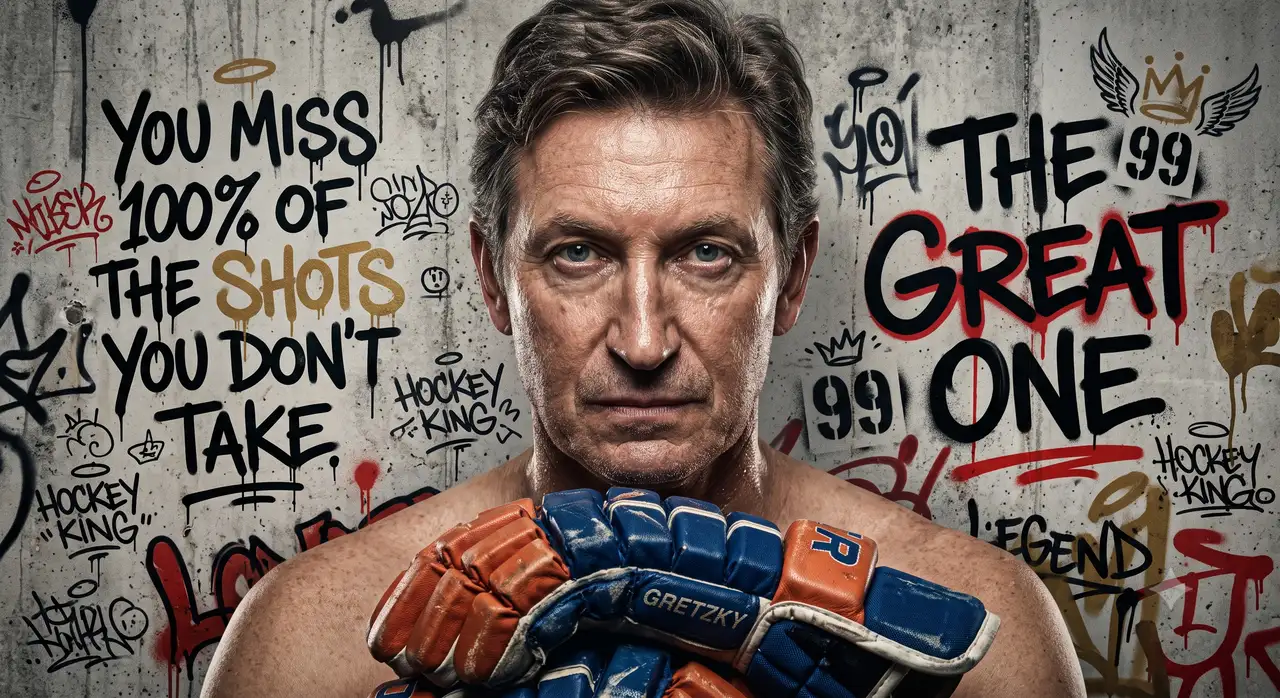
On August 9, 1988, in a packed room at Edmonton's Molson House, the best hockey player anyone had ever seen wiped tears from his face and could barely finish a sentence. "I promised Mess I wouldn't do this," Wayne Gretzky said, referring to teammate Mark Messier, before losing his composure again. The Edmonton Oilers, fresh off their fourth Stanley Cup in five seasons, had just traded their 27-year-old captain to the Los Angeles Kings in a deal that also sent the Oilers three first-round draft picks and 15 million dollars. Canadian newspapers ran the trade as front-page news above the fold, some outlets treating it closer to a national tragedy than a sports transaction. It is still, decades later, referred to simply as "The Trade," no further description needed, because there has never been another hockey trade that carried anything close to the same weight.
That reaction only makes sense in the context of what Gretzky had already done and what he would go on to do, because "The Great One" is not hockey hyperbole so much as a literal description of a statistical gap that has no real parallel in professional team sports. Gretzky retired holding the NHL records for career goals (894), assists (1,963), and points (2,857), and his point total sits nearly 1,000 points ahead of the next player on the all-time list, a margin so large that it functions less like a record and more like a different tier of achievement entirely. He also holds the record for career hat tricks, at 50, more than fifteen ahead of anyone else. To put the assists number in particular into perspective, Gretzky's career assist total alone would rank him among the highest-scoring players in league history even if you didn't count a single one of his goals.
His individual seasons produced numbers that read like typos even by the standards of the high-scoring 1980s NHL. In 1985-86, Gretzky recorded 163 assists and 215 total points in a single 80-game season, both of which remain single-season records that have never been seriously approached since the league's scoring environment changed in the 1990s and 2000s. He also holds the single-season goals record among his own personal marks, 92 in the 1981-82 season, a total he reached in part by scoring 50 goals in just 39 games that year, obliterating a mark of 50 goals in 50 games that had stood since Maurice "Rocket" Richard set it in 1944-45 and had been treated as one of the sport's more unbreakable benchmarks. Gretzky posted 15 seasons of 100 or more points, 13 of them consecutive, a level of sustained dominance that current statisticians studying the modern, defensively tighter NHL consider effectively impossible to replicate under today's rules and coaching systems.
What made Gretzky's dominance especially unusual is that he achieved it without the size or raw physical power that typically define the sport's most feared players. Listed at roughly 6 feet and under 180 pounds for most of his career, he was frequently among the smaller and less physically imposing players on the ice, in a sport built around collisions and along-the-boards physicality. What he had instead was a hockey IQ that teammates, opponents, and coaches all independently described in nearly identical terms across four decades of interviews: an ability to anticipate where the puck and every player on the ice was going to be several seconds before it happened, positioning himself to receive passes in openings that didn't yet exist when he started moving toward them. He famously said he skated to where the puck was going to be, not where it had been, a habit of thought that turned positioning and anticipation into as reliable a weapon as any slap shot.
The Oilers dynasty Gretzky anchored won four Stanley Cups in five years between 1984 and 1988, built around a core that included Messier, Jari Kurri, Paul Coffey, and Glenn Anderson, a roster now regarded as one of the most talented single-era teams in league history. That championship pedigree is part of why the 1988 trade landed with such force: Gretzky wasn't a declining star being moved for financial reasons in any sporting sense, he was the best player in hockey, in his prime, on a team that had just won it all, sent to a Kings franchise that had never been a serious championship contender and existed largely in the shadow of Los Angeles's other professional sports teams.
The trade's consequences reshaped the entire geography of professional hockey in North America, and this is where Gretzky's importance extends well past his own statistics. His arrival in Los Angeles is widely credited by league historians with jump-starting hockey's expansion into non-traditional American markets, the Kings became appointment viewing overnight, and the NHL used the visibility Gretzky generated in Southern California to help justify expansion franchises in Florida, Arizona, Nashville, and other warm-weather markets through the 1990s that would have been difficult to justify commercially without evidence that hockey could draw an audience outside its traditional Canadian and northern U.S. strongholds. Gretzky didn't just move a franchise's fortunes; he moved the league's entire long-term business strategy.
Gretzky's later career, spent with the Kings, then briefly with the St. Louis Blues, and finally with the New York Rangers before his retirement in 1999, never recaptured Edmonton's championship success, and that lack of a Cup after the trade is occasionally cited by critics attempting to build a case against him in all-time rankings. It's a thin argument set against nine Hart Trophies as the league's regular-season MVP, a total more than double any other player in league history, and a career built on statistical dominance that has no comparable case anywhere else in the sport. Mario Lemieux, Gretzky's closest rival for the "best ever" conversation among hockey historians, produced arguably higher per-game scoring rates during his own healthy seasons but battled cancer and chronic back injuries that limited him to a fraction of Gretzky's total games played, making a career-total comparison difficult on its own terms even as a peak-rate argument remains genuinely competitive.
Gretzky's number, 99, is retired league-wide across the entire NHL, the only number in the sport's history to receive that honor, a formal acknowledgment that no player should ever wear it again. It is a fitting piece of trivia for a career built almost entirely out of numbers no one else has come close to matching, some of them likely permanent fixtures at the top of the record book for as long as the sport is played.
With scoring environments having changed so dramatically since the 1980s, is Gretzky's point total still a fair measure of the greatest player ever, or does it primarily reflect the era he played in?