Atlanta, July 19, 1996. The Olympic stadium doesn't know who is about to walk out of the shadows to light the cauldron, and when the figure steps into the light, holding the torch in a hand shaking visibly from Parkinson's disease, the crowd of more than 80,000 people erupts in a way Olympic opening ceremonies rarely produce. Muhammad Ali, three decades removed from his gold medal in Rome and more than a decade into a disease that had taken his voice and steadied hands, lit the flame anyway. It remains one of the most replayed images in the history of the Games, not because of what it showed about fire or ceremony, but because of what it showed about a man who built his entire public life on defiance, still standing in front of the world on his own terms.
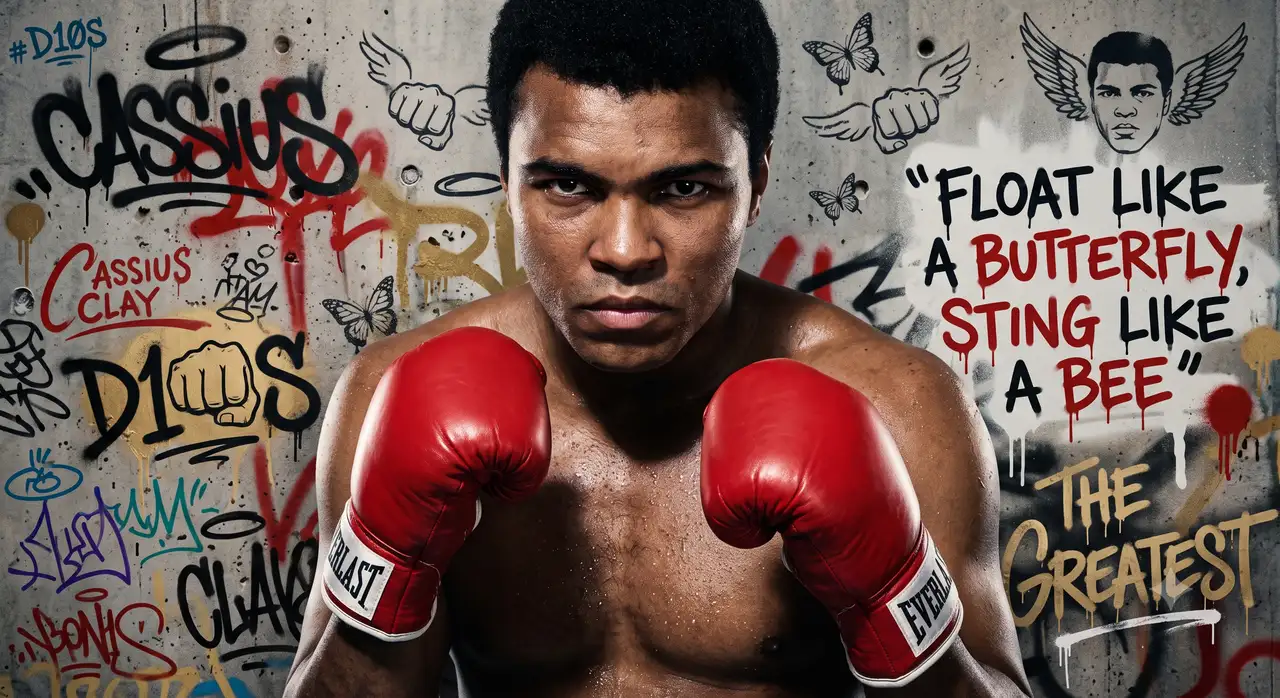
Ali's boxing record supports every superlative attached to his name, but the record alone undersells him. He finished his career 56-5 with 37 knockouts, and became the first fighter in history to win the world heavyweight championship on three separate occasions, defending it a combined 19 times across those reigns. He won Olympic gold as an 18-year-old light heavyweight in 1960 under his birth name, Cassius Clay, then turned professional and worked his way to a title shot against Sonny Liston in 1964, a fight almost nobody outside his own camp expected him to win. Ali predicted the round he would knock out Liston and told reporters he would "float like a butterfly, sting like a bee," a phrase that became so associated with him it now functions as cultural shorthand for elegant power. He won that fight and, at 22, became heavyweight champion of the world.
What happened next changed the entire shape of his legacy. In 1967, at the height of his fame, Ali refused induction into the U.S. Army during the Vietnam War, citing his religious beliefs as a member of the Nation of Islam and declaring that he had no quarrel with the Viet Cong. The consequences were immediate and severe: he was stripped of his heavyweight title, banned from boxing, and convicted of draft evasion, facing a five-year prison sentence. He did not fight for three and a half years, from age 25 to nearly 29, the athletic prime that should have defined a heavyweight career, instead touring college campuses and speaking publicly about race, religion, and conscience at a moment when doing so carried real professional and legal risk. The Supreme Court unanimously overturned his conviction in 1971, and Ali returned to the ring, but the years lost were never given back. Analysts still debate what his record might have looked like without that gap, a rare case in sports history where an athlete's greatest sacrifice may have cost him some of his own statistical legend.
The fights that followed his return became the defining trilogy of the sport's golden era. Ali lost his first attempt to reclaim the title to Joe Frazier in 1971's "Fight of the Century," then rebuilt his case with a series of wins that set up the "Rumble in the Jungle" against George Foreman in Kinshasa, Zaire, on October 30, 1974. Foreman was younger, heavier, and considered nearly unbeatable, having demolished both Frazier and Ken Norton, the two men who had beaten or troubled Ali in recent years. Ali, given little chance by most experts, spent much of the fight leaning against the ropes, absorbing punishment while covering up, a strategy he later named the "rope-a-dope." Foreman punched himself into exhaustion trying to end the fight early. In the eighth round, Ali came off the ropes and knocked Foreman out, reclaiming the heavyweight title seven years after it had been taken from him for reasons that had nothing to do with boxing.
The final chapter of the Frazier rivalry, the "Thrilla in Manila" in October 1975, is remembered as one of the most brutal heavyweight fights ever contested. Both men fought past the point most observers thought either could sustain, trading punishment for fourteen rounds in extreme heat before Frazier's trainer stopped the fight, his fighter's eyes swollen nearly shut and unable to answer the bell for the final round. Ali later said the fight felt like "the closest thing to dying" he had experienced, a comment that has taken on more weight in hindsight given the toll years of championship boxing eventually took on his health.
Ali's influence outside the ring is arguably even harder to overstate than his record inside it. He was, alongside Jackie Robinson, one of the most consequential athlete-activists in American history, using his platform during the civil rights era to speak on Black identity, religious freedom, and opposition to war at a time when doing so meant real financial and legal punishment, not just public criticism. His conversion to the Nation of Islam and his rejection of the name Cassius Clay as, in his words, a "slave name," made him a lightning rod for a country still working through segregation and civil rights, and he absorbed enormous hostility from parts of the press and public for stances that are now widely regarded, including by many former critics, as principled. He turned boxing press conferences into performance art, popularizing a style of pre-fight trash talk and self-promotion that shaped how virtually every combat sports promoter and fighter markets a bout today. Sportswriters voted him "Sportsman of the Century" and the BBC named him its "Sports Personality of the Century," recognitions less about his win total than about the size of the cultural space he occupied.
Ali's later years, defined by his public battle with Parkinson's disease, added a different kind of gravity to his legacy. Diagnosed in 1984, three years after his final fight, Ali spent the following decades appearing at public events with a visibly diminished physical presence, his once-rapid speech slowed and his hands trembling, yet he remained a constant presence at humanitarian and diplomatic events, traveling internationally as a goodwill ambassador. The 1996 torch lighting distilled that later chapter into a single image: a man whose body had betrayed the very qualities, speed and dexterity, that made him famous, choosing to appear before the largest possible audience anyway.
Judged strictly on fights, Ali's case for the title of greatest heavyweight ever competes with Joe Louis's long reign, Rocky Marciano's unbeaten record, and later, Larry Holmes and Mike Tyson at their respective peaks. What sets Ali apart in that argument is less any single statistic than the totality of what he did with the platform boxing gave him: the audacity of the Liston prediction, the endurance of Manila, the tactical brilliance of the rope-a-dope against a bigger, younger opponent, and a willingness to sacrifice his prime years for a political and religious conviction that the country he represented did not, at the time, agree with. Few athletes in any sport have combined that level of competitive genius with that degree of consequence outside the arena.
He called himself "The Greatest" before he had fully proven it, a boast that in almost any other athlete would have aged badly. Ali spent the next two decades making the claim look understated.
Was Ali's greatest victory the one over George Foreman in Kinshasa, or the fight he never had to throw a punch in, against the U.S. government over his right to refuse the draft?