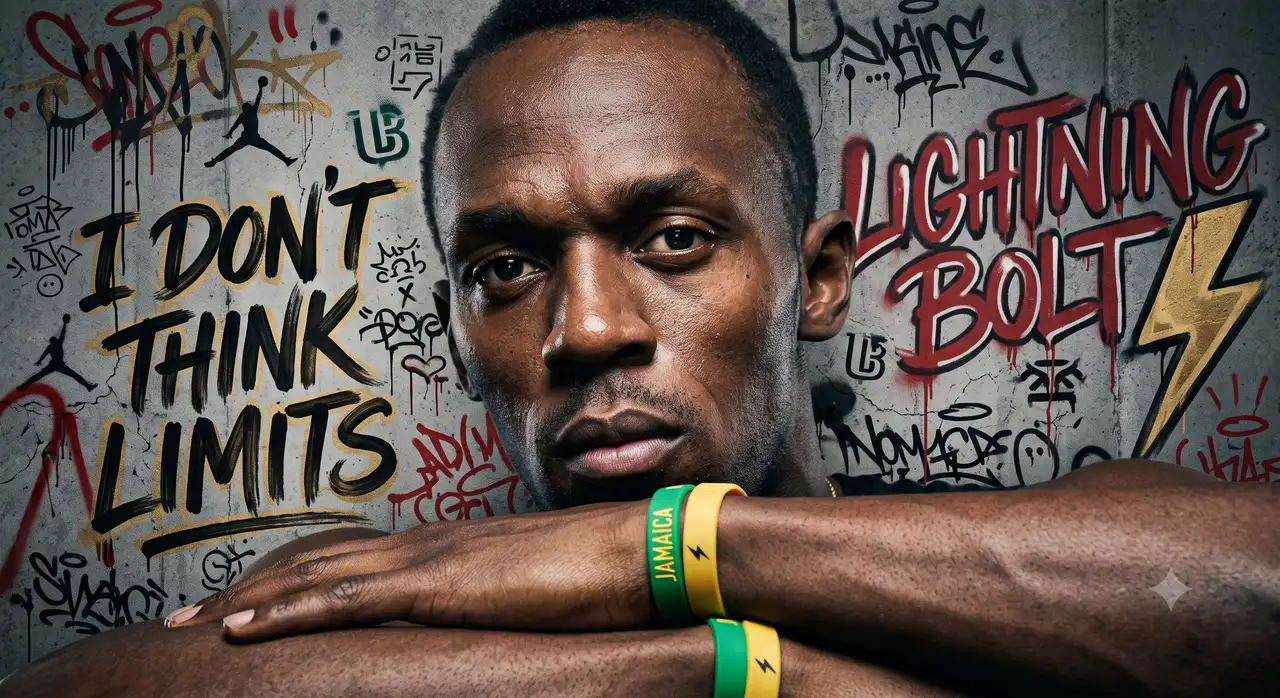
His shoelace was untied. That's the detail that tends to get lost in the retelling of Usain Bolt's 100-meter final at the 2008 Beijing Olympics: the world's fastest man ran the last thirty meters of an Olympic final and a world-record time with a loose shoe, arms spread wide in celebration well before the finish line, chest-thumping across the line in 9.69 seconds anyway. He hadn't even run a clean race by his own later standards, and he still broke the world record by more than a tenth of a second, a margin that in sprinting terms is closer to a canyon than a gap. It was the moment the world learned what Usain Bolt actually was, and over the next eight years he kept finding new ways to prove the first impression hadn't been an exaggeration.
Bolt's statistical case for the greatest sprinter in history is, unusually for track and field, close to uncontested. He set the current 100m world record of 9.58 seconds and the 200m world record of 19.19 seconds, both at the 2009 World Championships in Berlin, times that remain unbroken more than fifteen years later in a sport where records typically fall in increments measured in hundredths of a second every few years. He won gold in the 100m and 200m at three consecutive Olympics, Beijing 2008, London 2012, and Rio 2016, a "double-double-double" no sprinter before or since has managed, and added relay gold at each of those Games as well, giving him nine Olympic gold medals across his career. At the 2008 Beijing Games alone he became the first man in history to set world records in the 100m, 200m, and 4x100m relay at a single Olympics. The nickname "Lightning Bolt" wasn't marketing hyperbole. It was closer to a factual description.
What separated Bolt physically from the sprinters who came before him was a combination that shouldn't have worked according to conventional sprinting theory. At 6-foot-5, he was significantly taller than nearly every elite sprinter in history, a build that biomechanics experts had long assumed was a disadvantage in the 100m because of the extra time needed to get long limbs moving at full speed out of the blocks. Bolt turned that assumption upside down. His height gave him a stride length no competitor could match once he reached top speed, often needing several fewer strides to cover the same distance as rivals with far quicker turnover. He was consistently among the slowest starters in any given Olympic final, visibly behind the field twenty meters in, and then simply ran everyone else down over the second half of the race, a pattern so repeatable that broadcasters and rival coaches began building their race commentary specifically around waiting for the moment Bolt would pull past the field.
The showmanship that came with the talent is part of what made him the sport's biggest global star since the era of Carl Lewis and Michael Johnson, arguably bigger. The lightning-bolt pose, arms cocked like he was firing an arrow into the sky, became one of the most recognized celebratory gestures in world sport, performed at finish lines and on victory podiums as a signature as identifiable as any athlete's uniform number. He ran with a showman's sense of timing, famously slowing to celebrate before the finish line in Beijing, then went on record saying he believed he could have run faster than 9.58 seconds in Berlin the following year had he not been managing the race rather than sprinting flat out the entire way. Track and field is a sport that has often struggled for mainstream attention between Olympic cycles. Bolt, for the better part of a decade, was reliably the exception, a guaranteed ratings draw and front-page story regardless of the meet.
His run of dominance wasn't spotless, and the honest version of his story includes the setbacks. He false-started out of the 100m final at the 2011 World Championships in Daegu, disqualified from a race he was heavily favored to win, a reminder that even historic dominance leaves room for a single bad moment to end everything instantly. Injuries increasingly shaped his final competitive years, and his body, after a decade of races run at speeds it was never designed to sustain, began to show the wear that eventually forced his retirement plans into the open.
That decline played out publicly and painfully at the 2017 World Championships in London, his announced retirement meet. Bolt finished third in what was billed as his final individual 100m race, beaten by Justin Gatlin and Christian Coleman in a result that stunned a stadium expecting a storybook ending. Two days later, running the anchor leg of Jamaica's 4x100m relay in what was meant to be a victory lap for his career, Bolt pulled up in visible pain partway through his leg of the race, his hamstring torn, and collapsed to the track before hobbling and eventually crawling across the finish line as the stadium fell into stunned silence. The image of Bolt on the ground, unable to finish the race the way he had finished nearly every other race of his career, at full speed and ahead of the field, became its own kind of iconic moment, a rare glimpse of vulnerability from an athlete whose entire brand had been built on effortless superiority. He rose, limped the final stretch to a standing ovation, and took a slow farewell lap around the London Stadium as Bob Marley's "One Love" played, a scene that turned what was supposed to be a celebration into something closer to a wake, and then, within a lap, back into a celebration anyway, the crowd determined to send him off properly regardless of how the race had ended.
Comparisons to earlier sprint legends, Carl Lewis's four consecutive Olympic 100m-adjacent dominance in the 1980s and early '90s, or Michael Johnson's 200m and 400m double at Atlanta 1996, tend to collapse quickly under the weight of Bolt's numbers. Lewis never ran anywhere close to Bolt's times, a function partly of different eras of training and technology, and Johnson, while historically dominant in his events, never held both marquee sprint world records simultaneously the way Bolt did for over a decade. The more interesting debate isn't really about who was faster; it's about what "greatest" should mean in a sport where technology, track surfaces, and shoe design have genuinely changed the conditions athletes compete under across generations. By any reasonable version of that debate, Bolt's combination of times that still stand, Olympic sweep across three Games, and a level of showmanship that expanded his sport's audience well beyond its usual reach, puts him alone at the top of track and field's modern era.
Sprinting is, in some ways, sport reduced to its simplest form: run in a straight line, faster than everyone else, for less than ten seconds. Bolt did that better than any human being ever measured doing it, and did it while making the ten seconds feel like a performance rather than just a race. Nearly a decade after his final competitive stride, in a sport obsessed with the next record and the next prodigy, his times in Berlin remain untouched, and no one competing today has come particularly close.
With his world records still standing more than fifteen years on, has sprinting simply found its ceiling, or is the next Bolt still waiting to be discovered?