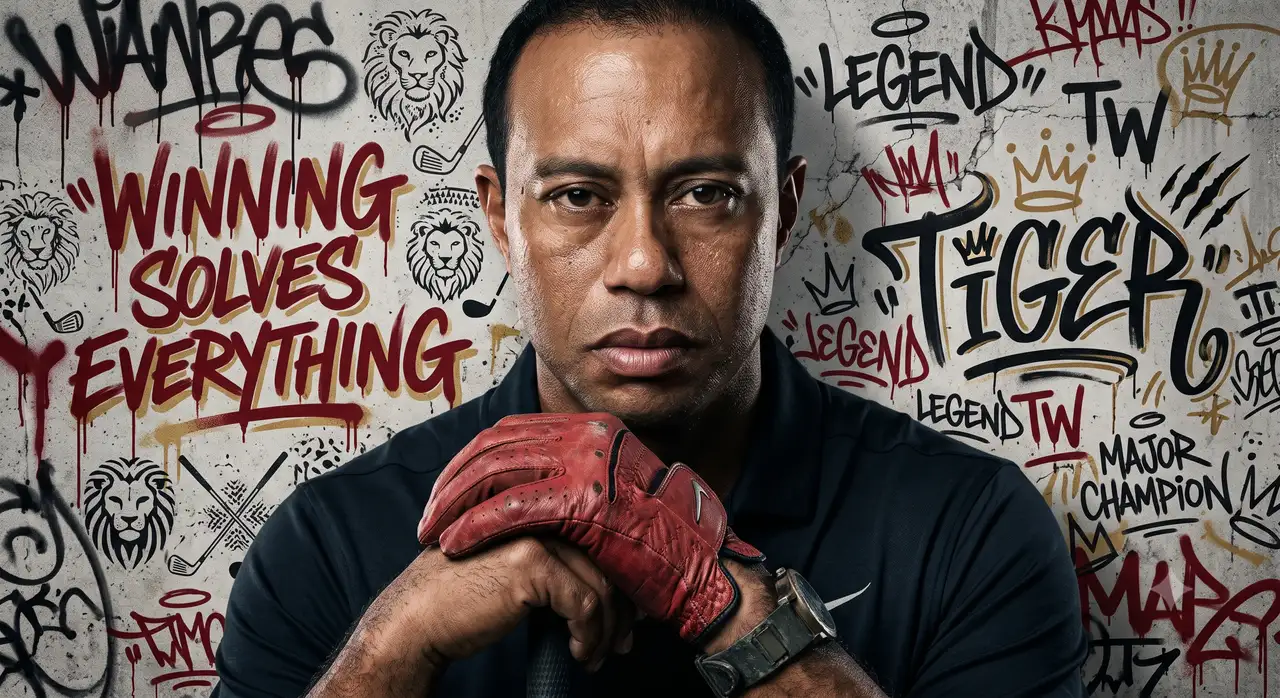
The green jacket was still being fitted around his shoulders when Tiger Woods walked off the 18th green at Augusta National in April 2019 and looked for his children in the crowd. His son Charlie ran to him first, and Woods scooped him up in an embrace that instantly evoked another hug on that same patch of grass, 22 years earlier, when a 21-year-old Woods had wrapped his arms around his father Earl after winning his first Masters by 12 strokes. Earl had died in 2006. Woods had been through four back surgeries, a highly public personal scandal, and years in which he could barely walk without pain, let alone swing a club competitively. "To have my kids there, it's come full circle," he said afterward. "My dad was here in '97, and now I'm the dad with two kids there." It was his fifth Masters title and his 15th major, arriving eleven years after his previous one, a gap long enough that much of the golf world had quietly written the pursuit off as over.
That comeback victory sits at the emotional center of Woods's story, but the case for him as the golfer who changed the game rests on a body of work that started shaking up the sport well before the comeback and the scandal that preceded it. Woods turned professional in 1996 and won the 1997 Masters as a 21-year-old, becoming the youngest champion in tournament history and, at the time, the first golfer of Black or Asian heritage to win a major, a milestone that carried weight well beyond the leaderboard in a sport with a long history of exclusion at the country-club level. He completed the career Grand Slam by 24, the youngest player ever to do so, and then produced the "Tiger Slam," holding all four professional major titles simultaneously across the 2000 and 2001 seasons, a feat no other golfer in the sport's history has managed, before or since.
The scale of his dominance in that early period is difficult to convey to golf fans who came to the sport afterward. Woods won the 2000 US Open at Pebble Beach by 15 strokes, the largest margin of victory in a men's major championship in more than a century, a performance so complete that the rest of the field finished the tournament closer to each other than to him. He ultimately finished his career with 82 PGA Tour victories, tied with Sam Snead for the most in tour history, and 15 major championships, second only to Jack Nicklaus's 18, a gap that shaped the sport's central statistical debate for the better part of two decades. He set the record for most consecutive cuts made on tour at 142, a streak spanning seven years that reflected not just talent but a level of week-to-week consistency almost no one else in the sport's history has matched.
What made Woods different from the golfers who came before him wasn't just execution, it was the combination of power and precision he brought to a sport that had traditionally rewarded either one or the other but rarely both at an elite level simultaneously. He hit the ball dramatically farther than most of his peers while also possessing a short game and putting touch refined enough to close out majors under maximum pressure, a combination that forced an entire generation of competitors to overhaul their fitness regimens and swing mechanics just to stay competitive. Golf courses were physically redesigned and lengthened across the sport in direct response to Woods's driving distance, a phenomenon golf architects came to refer to informally as "Tiger-proofing." Television ratings for tournaments he played in routinely dwarfed those he sat out, and sponsorship dollars flowing into the sport during his prime years expanded the entire economic scale of professional golf, from prize money to endorsement deals for players well outside his own bracket.
The years between 2009 and 2017 form the difficult middle chapter of his career, and any honest account has to include them. A November 2009 car accident outside his home led to public revelations of marital infidelity that ended his marriage and unraveled a carefully built public image almost overnight, costing him major endorsement deals and a period away from competition. Physically, his body began breaking down under the accumulated strain of a swing built for power, and multiple back surgeries between 2014 and 2017 left him at points barely able to get out of bed, let alone compete. He underwent spinal fusion surgery in April 2017, and by his own account had genuinely uncertain prospects of playing competitive golf again at any level, let alone contending for majors.
The 2019 Masters victory, then, wasn't simply another tournament win. It closed a gap of personal and physical adversity that few athletes at that level of previous dominance have ever climbed back from, and it did so on the same course, in the same tournament, that had launched his career in the first place. Golf analysts and rival players alike have described it as one of the most improbable comebacks in the sport's history, not because Woods lacked talent, but because the physical toll of the years before it had seemed, at multiple points, to have ended his competitive career entirely.
The debate over where Woods ranks against Jack Nicklaus, the only player with more major titles, tends to center on two different definitions of greatness. Nicklaus's 18 majors, achieved across a longer competitive prime with fewer major injury setbacks, represent the standard by pure accumulation. Woods's advocates argue that his level of dominance at his peak, the margins of victory, the consecutive weeks at world number one, and the way he forced an entire sport to physically and technically reorganize around competing with him, represent a different and arguably higher form of greatness than total count alone captures. Both cases are legitimate, and the debate persists in large part because Woods's comeback added years to a career many had assumed had already reached its final chapter well before 2019, muddying any simple comparison of two complete careers.
Woods changed the financial scale of professional golf, changed the athletic standard other golfers had to meet just to compete, and did it while becoming one of the most recognizable athletes on the planet regardless of whether a viewer followed golf at all. The hug with Charlie in 2019 mattered because it closed a story that had, at several points along the way, looked finished for reasons that had nothing to do with talent.
Does an era-defining peak, complete with a Tiger Slam no one has repeated, outweigh Jack Nicklaus's larger total of major championships won over a longer competitive prime?