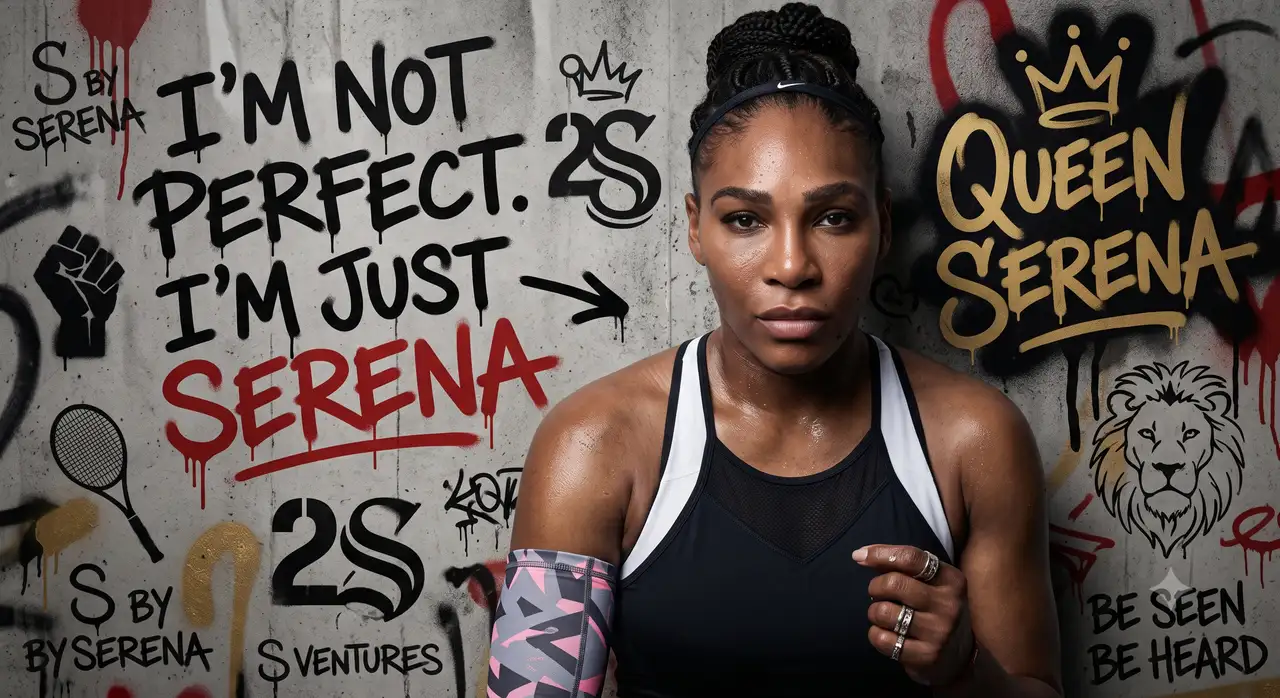
Eight weeks pregnant, though almost no one outside her camp knew it at the time, Serena Williams walked onto Rod Laver Arena for the 2017 Australian Open final against her sister Venus and won 6-4, 6-4 without dropping a set anywhere in the tournament. It was her 23rd Grand Slam singles title, the most of the Open Era, achieved under conditions that would have sidelined most professional athletes entirely. Years later, asked to name the single biggest moment of her career, Williams didn't point to a Wimbledon final or an Olympic gold. She pointed to that one. "I don't know how I did that," she said, looking back on it. The answer, as much as any athlete has ever offered one, is Serena Williams in a single sentence: extraordinary performance delivered under circumstances nobody else would have attempted to compete in at all.
The scale of her career resists easy summary, so start with what's uncontested. Williams won 23 Grand Slam singles titles, seven at the Australian Open, three at the French Open, seven at Wimbledon, and six at the US Open, the most of any player, man or woman, in the Open Era, which began in 1968. Only Margaret Court's 24 majors sit ahead of her total, and 13 of those came during the amateur era before professionals were even permitted to compete at the sport's biggest events, a fundamentally different competitive landscape. Williams finished her career with a singles record of 858-156 and 367 Grand Slam match wins, second all-time only to Roger Federer among every player in tennis history, male or female. She held all four major titles simultaneously on two separate occasions, a feat so demanding that it earned its own nickname, the "Serena Slam," first in 2002-03 and again in 2014-15, more than a decade apart, a gap that speaks directly to the sustained nature of her dominance rather than a single hot stretch.
What made her nearly impossible to play was the combination of power and precision that simply didn't exist in the women's game before her. Williams' serve, at its peak, was clocked among the fastest ever recorded in the women's sport, and she paired it with a return game and groundstrokes that could end points from either baseline corner. Opponents didn't just lose to her, they were frequently overwhelmed in ways that changed how the entire sport trained its next generation. Junior programs around the world shifted toward power-based training regimens in direct response to watching what Williams could do to opponents who relied purely on placement and consistency. She forced the sport to get stronger, faster, and more physical to keep pace, a rare case of one player's game reshaping an entire competitive ecosystem rather than simply excelling within it.
Longevity is the other pillar of her case, and it may be the more remarkable one. Williams won her first major, the 1999 US Open, as a 17-year-old, and her last, the 2017 Australian Open, at 35, an 18-year gap between first and final Grand Slam title that has no real precedent among the sport's other legends. She competed at an elite level across four different decades of tennis, adapting her game as her body changed and as opponents a generation younger arrived specifically trained to beat her. She survived multiple serious health scares, including a pulmonary embolism in 2011 that required emergency treatment and kept her off tour for most of a year, and returned each time to compete for major titles rather than settle into a diminished role.
Her rivalry and partnership with her sister Venus sits at the emotional core of her story in a way few sibling dynamics in sports history can match. The two grew up training on public courts in Compton, California, under their father Richard Williams' famously unconventional and demanding coaching methods, and rose together into the top of the sport before repeatedly meeting each other in the finals of the tournaments both were trying to win. Nine times they met in Grand Slam finals, a rivalry that could easily have curdled into resentment but instead produced some of the most gracious sportsmanship in the sport's history, each sister crediting the other publicly and often, even in defeat. When Serena won that pregnant Australian Open final over Venus, she used her trophy speech to redirect credit to her sister: "There is no way I would be at 23 without her. She is my inspiration, she is the only reason I am standing here today." It was a title she had just taken from Venus directly, and the first instinct in victory was still gratitude toward her.
That same dynamic returned, more painfully, at her actual farewell. Williams played what she called her final match at the 2022 US Open, losing in the third round to Ajla Tomljanović in a match that ran past midnight in front of a Flushing Meadows crowd that refused to let the moment end quietly. In her on-court interview afterward, Williams broke down describing what tennis and her family had given her. "Thank you daddy, I know you're watching," she said, before turning again to her sister. "I wouldn't be Serena if there wasn't Venus. She's the only reason Serena Williams ever existed." It was the same sentiment from 2017, delivered this time not in triumph but in farewell, and it captured something true about how she understood her own career: extraordinary individual achievement built, from the very beginning, on a partnership she never stopped acknowledging.
Williams' significance extends well past her trophy case. She competed and won at the highest level of a traditionally country-club sport as a Black woman from Compton, facing scrutiny over her body, her clothing, her on-court emotion, and her demeanor that her white peers were rarely subjected to in the same way, and she did it while becoming the sport's biggest draw and highest earner. She became a prominent voice on maternal health after her own near-fatal complications following the birth of her daughter Olympia in 2017, using her platform to highlight the disproportionately high rates of pregnancy-related complications among Black women in the United States. She built a business and investment portfolio well beyond tennis, and her influence on how young athletes, particularly young Black girls, see themselves in sports historically closed off to them is difficult to measure in trophies but impossible to overstate.
The GOAT conversation in women's tennis inevitably runs through Williams, Steffi Graf, and Margaret Court, and honest analysis has to hold real nuance about all three. Graf won a calendar Grand Slam plus Olympic gold in 1988, a single season no other player has matched, and finished with 22 majors against a very strong field of competitors. Court's 24 majors remain the record by count, though the bulk came during the amateur era against a shallower international field than the Open Era Williams competed in for two decades. Williams' advocates argue that the combination of major count, longevity spanning four decades, dominance across all four surfaces, and the sheer physical transformation she forced on the sport puts her alone at the top. It's a case built on evidence rather than sentiment, even if it will never fully settle an argument that, by its nature, crosses eras that can't be perfectly compared.
What can be settled is the shape of the story itself: a teenager from Compton who became the most feared server in the sport's history, who won major titles as a rookie and as a mother, who lost to nobody more often than she lost to her own sister, and who left the game the way she entered it, crying, grateful, and still somehow the center of the room.
Does Serena's 18-year span between her first and last major title matter more, in judging true greatness, than Steffi Graf's single perfect season?