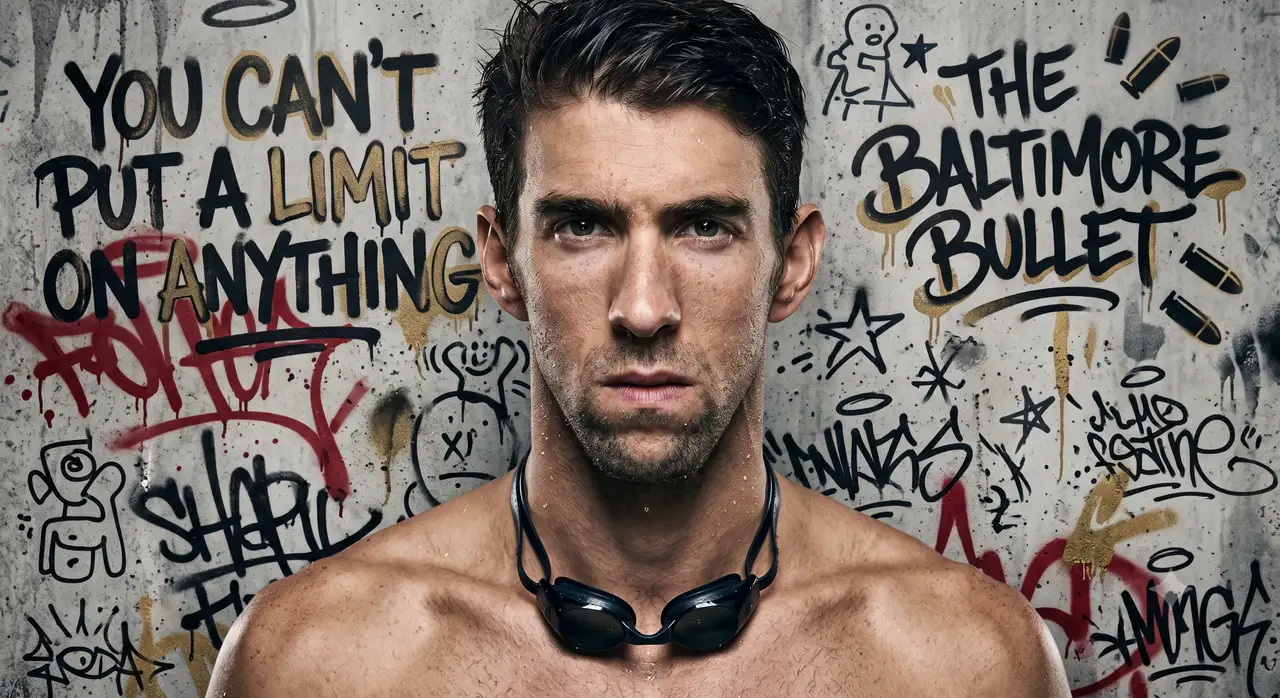
Eight events, eight gold medals, seven world records, one Games. Beijing 2008 remains the single greatest individual medal haul in Olympic history, and Michael Phelps produced it swimming a program so grueling that his coach, Bob Bowman, had built years of training specifically around the accumulated fatigue of racing that many times in nine days. The closest anyone had come before him was Mark Spitz, who won seven golds at the 1972 Munich Games, a total that stood as an almost mythical ceiling for thirty-six years. Phelps didn't just clear that ceiling. He swam through it and kept going, and by the time he finally left the sport for good he had built a medal count that may never be threatened again, in any Olympic sport, by any athlete.
The full scope of the numbers is difficult to process even in outline form. Phelps is the most decorated Olympian in history with 28 total medals, including 23 gold, spread across five Games: six golds and two bronzes at Athens 2004, the historic eight golds at Beijing 2008, four golds and two silvers at London 2012, and five golds and a silver at Rio 2016. To put the gold-medal count alone in context, only four entire countries have ever won more Olympic gold medals across their whole national team history than Phelps won by himself. He set a men's world record in the 400m individual medley as a 22-year-old in Beijing that stood for years, and across his career held world records simultaneously in multiple individual events plus multiple relays, a level of range that swimming had not seen from a single athlete before and has not seen since.
What made that range possible was a physical profile that swimming coaches still describe as close to ideally engineered for the sport, even if Phelps himself has resisted the idea that genetics alone explain his career. His wingspan, roughly three inches longer than his height, gave him a reach advantage in the water that few competitors could match, paired with a torso built for pulling power and a double-jointed flexibility in his ankles that let him generate propulsion other swimmers physically couldn't replicate with a normal kick. But the physical gifts only explain part of the dominance. Bowman built a training program around Phelps that was, by most swimmers' standards, close to punishing, and Phelps's willingness to sustain that volume of work for years, without the kind of off-seasons other elite swimmers took, is as much a part of the story as the wingspan. He was, by his own description and his coach's, obsessive about the process in a way that eventually became inseparable from what made him great and, later, part of what nearly broke him.
The moment that best captures his competitive range wasn't even a gold medal. It was the 100m butterfly final in Beijing, where Phelps trailed Serbia's Milorad Čavić for almost the entire race and appeared beaten with meters to go, only to close with a final surging stroke that touched the wall one-hundredth of a second ahead, the smallest possible margin in the sport, to preserve the eight-for-eight run. That race is frequently cited by swimming analysts as the single moment that made the entire Beijing performance possible; a loss there would have ended the pursuit of Spitz's record with one event still to go, and instead it became the tightest and most dramatic swim of his career.
The story that eventually made Phelps more than a record-setting swimmer, though, is what happened after the medals stopped being enough. Following the 2012 London Games, where he'd won six more medals and appeared, publicly, to be at the peak of a career already regarded as the greatest in Olympic history, Phelps fell into a depression severe enough that he later said he considered ending his life. He described the years around his early, temporary retirement as some of the darkest of his life, a period largely invisible to the public that had just watched him dominate another Olympics. "I was pretty positive that I didn't want to be alive anymore," Phelps said years later, discussing it publicly for the first time in interviews and in the HBO documentary "The Weight of Gold," which he helped produce specifically to address what he has called an epidemic of depression and suicidal thoughts among elite athletes, particularly Olympians who spend years defined entirely by a single performance every four years and then struggle to find identity once the competition ends. With the help of his longtime coach and a period of treatment, Phelps returned to the pool and won five more golds at Rio in 2016, closing his competitive career the way he'd opened it, with world-class swimming, but this time as an athlete who had been public and specific about the cost that level of achievement had exacted.
That openness reshaped how Phelps is remembered nearly as much as the medal count did. He became one of the most visible advocates for athlete mental health in American sports, a subject that was rarely discussed publicly by top-tier competitors before his disclosures, and his willingness to describe his own struggles in detail gave permission to a generation of younger athletes, across multiple sports, to talk about similar experiences without the stigma that had previously kept most of it hidden. Simone Biles and other Olympians who later spoke openly about mental health during competition have cited Phelps's example directly as part of what made those conversations possible.
Judged purely against swimming's history, Phelps's case is close to uncontested. Spitz's seven golds in a single Games remain the standard against which every subsequent swimmer is measured, and Katie Ledecky's ongoing dominance across multiple Olympic cycles has produced its own extraordinary résumé in distance freestyle events. Neither approaches the combination of total medal volume, event range, and sustained excellence across four Olympic cycles that Phelps accumulated between 2004 and 2016. The broader "greatest Olympian ever" conversation, spanning every sport rather than just swimming, inevitably has to grapple with the fact that swimming's competition schedule simply offers more medal opportunities per Games than most other Olympic sports, a structural advantage worth acknowledging honestly rather than ignoring. Even with that caveat weighed fairly, the range of events Phelps mastered, from sprint butterfly to distance individual medley, and the world records he held across nearly all of them simultaneously, sets a bar that no swimmer competing today is within reach of approaching.
Phelps's story, in full, is really two careers stitched together: one defined by a medal count that reset the ceiling for what a single Olympic athlete could achieve, and a second, quieter one defined by what that pursuit cost him and what he chose to do once he'd survived it. Both halves are part of why his name still functions as the single-word answer to "greatest Olympian" in most conversations, more than a decade after his final race.
Does the sheer volume of Phelps's medal count, built partly on swimming's uniquely deep event schedule, make him the greatest Olympian ever, or does that structural advantage make the comparison to single-event legends unfair?