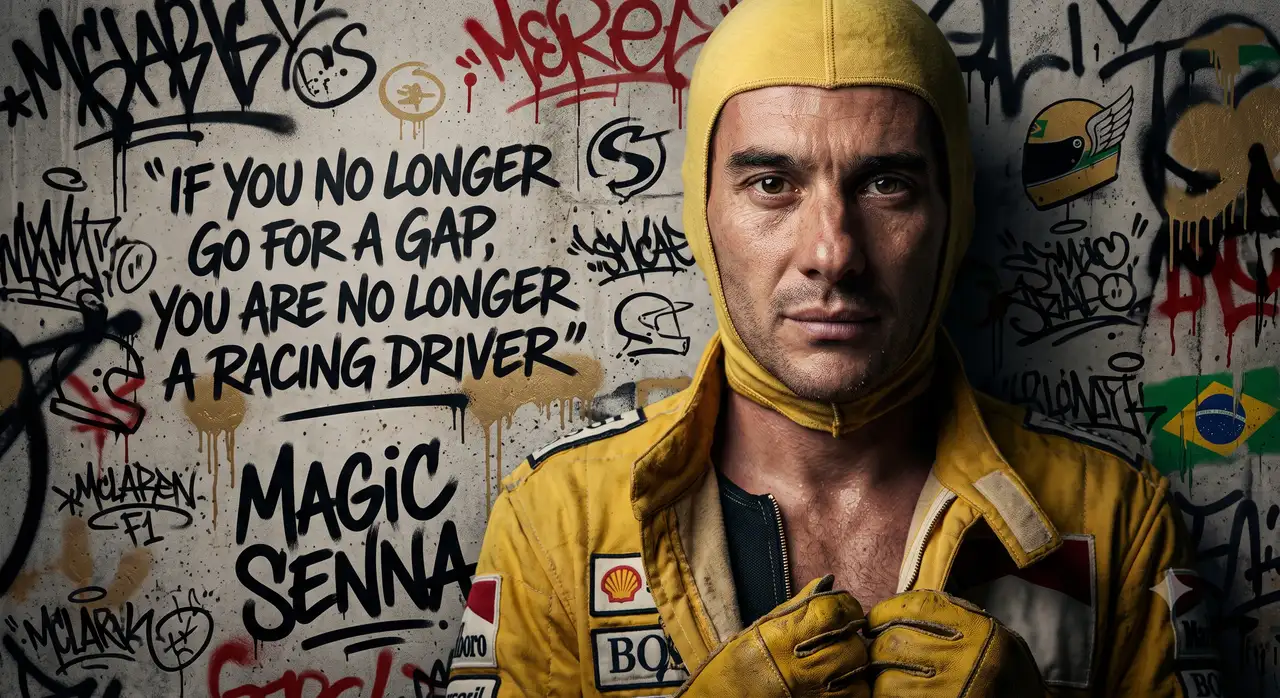
He crossed the finish line at Interlagos and let out a scream over the radio that had nothing to do with triumph and everything to do with what it had cost him to get there. Ayrton Senna had never won his home Brazilian Grand Prix, not in a car that mattered, despite years of trying in front of the fans who considered him a national treasure before he'd proven anything at all. In 1991, his gearbox failed with laps still to go, stuck in sixth gear on a demanding, twisting circuit that punished every mistake, forcing him to physically muscle the car through corners it was never designed to take in that gear. By the time he crossed the line, his body had seized up from cramping so severe that Formula 1's medical chief, Professor Sid Watkins, had to help lift him from the cockpit. On the podium, Senna could barely raise the winner's trophy above his head, gritting through visible pain as the crowd roared anyway. "By the finish, I had nothing left," he said afterward. "God gave me this race." It remains, for many who watched it, the single most physically extraordinary victory in the sport's history, a race won as much through will as through car control.
That combination, technical brilliance paired with a level of intensity that bordered on the spiritual, defined Senna's entire career and is why, more than thirty years after his death, he remains the reference point most drivers and fans reach for when describing what raw talent in Formula 1 looks like. He won three world championships, in 1988, 1990, and 1991, all with McLaren, and at the time of his death held the record for career pole positions with 65, a mark that reflected a qualifying ability regarded by rivals and engineers alike as close to unmatched, a driver who consistently extracted lap times from a car that looked, to onlookers, like they shouldn't have been physically possible. He won 41 Grands Prix across eleven seasons, a career built less on volume than on moments of individual brilliance in conditions where almost everyone else on the grid was visibly struggling.
Wet-weather driving became Senna's signature, the conditions where the gap between him and the rest of the field widened most dramatically. His 1984 Monaco Grand Prix debut season drive in a comparatively underpowered Toleman, closing rapidly on race leader Alain Prost in torrential rain before the race was controversially stopped, first announced him to the sport as a driver capable of something the established order hadn't seen before. He went on to win at Monaco, one of the sport's most demanding and unforgiving circuits, six times, a track record that still stands today and that drivers across multiple subsequent generations have specifically cited as the benchmark for mastering that circuit. Engineers who worked with him during his career described a driver with an unusual sensitivity to a car's balance, capable of detecting and communicating mechanical issues other drivers wouldn't notice until they became a problem, a technical feel that made him as valuable in development and setup work as he was on a qualifying lap.
His rivalry with Alain Prost defined an era of the sport and produced some of Formula 1's most controversial and consequential moments. The two were McLaren teammates for two seasons before their relationship deteriorated into open hostility, culminating in two separate title-deciding collisions at the Japanese Grand Prix, first in 1989, when Prost turned in on Senna and both drivers ended up in the gravel, then again in 1990, when Senna, having failed to secure what he considered a fair grid position from race officials beforehand, deliberately drove into Prost at the first corner to secure the championship, a decision he later admitted to publicly. The rivalry was never purely about racing lines; it touched questions of fairness, governance within the sport, and, in Senna's telling, what he saw as political favoritism toward Prost within the FIA, the sport's governing body. Their dynamic, equal parts mutual respect and genuine animosity, has been studied and dramatized more than perhaps any other rivalry in motorsport history, precisely because both men were, at their best, playing a different game than everyone else on the grid.
Senna's death is inseparable from how his career and legacy are now understood. On May 1, 1994, during the San Marino Grand Prix at Imola, Senna's car left the track at the high-speed Tamburello corner and struck a concrete barrier; a piece of suspension pierced his helmet, causing injuries he did not survive. He was 34. The accident came during a race weekend already shadowed by tragedy, after driver Roland Ratzenberger had died in a qualifying crash the day before, the sport's first fatality in over a decade at that point, a stretch of relative safety that had led many in Formula 1 to believe fatal accidents were becoming a thing of the past. Senna had reportedly grown increasingly vocal in the days before his death about safety concerns within the sport and had been elected to lead a newly reformed Grand Prix Drivers' Association specifically to push for safety reforms, an effort cut short by his own death. The accident, and Ratzenberger's the day before, are now widely credited by motorsport historians as the direct catalyst for the sweeping safety overhaul the FIA implemented through the following decade, changes to car design, circuit barriers, and medical response protocols that are credited with saving numerous lives in the years since, even as the sport lost the driver whose death helped force the reckoning.
Judged purely on trophies, Senna's three championships sit behind Michael Schumacher's seven, Lewis Hamilton's seven, and several other drivers who raced longer careers with fewer interruptions. That comparison, on its own, understates what made Senna's case for greatness distinct among a generation of Formula 1 fans and drivers who never saw a full career play out. His qualifying record, his wet-weather dominance, and the sheer intensity with which teammates and rivals described racing against him have made him a reference point that outlasts a simple count of titles, a driver frequently cited by later champions, including Schumacher and Hamilton themselves, as the standard they measured their own careers against rather than simply another name on the list ahead of or behind them.
Senna's career, cut short at what should have been closer to its midpoint than its end, leaves an unusual kind of legacy: not a complete statistical résumé to be measured against a full career's worth of rivals, but a body of individual performances, Monaco, Interlagos in 1991, entire wet-weather seasons, so far beyond what his competitors could produce that the incompleteness of the numbers around them has never diminished how the sport remembers him.
Should Senna's brilliance at his peak outweigh his lower total championship count next to drivers like Schumacher and Hamilton, who raced far longer, safer careers?